The Mirror of Apocalypse: Understanding Our Fears

The apocalypse isn’t just a genre. It’s a mirror.

From the moment we figured out time moves ahead, we’ve been obsessed with the moment it stops. We gather around a campfire sharing myths. Or, we doom-scroll on Twitter/X. Humanity has a strange, persistent hobby: we love rehearsing our own extinction.

As I’ve dug into this research for my blog, I’ve made discoveries. It has fuelled the concepts behind Nebula Arcana. I’ve realized that the “End” is rarely about death. It’s a diagnostic tool for the living. The monsters we invent are jaguars, floods, or AIs. They tell us exactly what we are afraid of right now.

Here is a tour through the architecture of the end: and why we can’t look away.

1. The Universe as a Buggy Software Update

If you think the world feels unstable today, you should see the Aztec maintenance schedule.

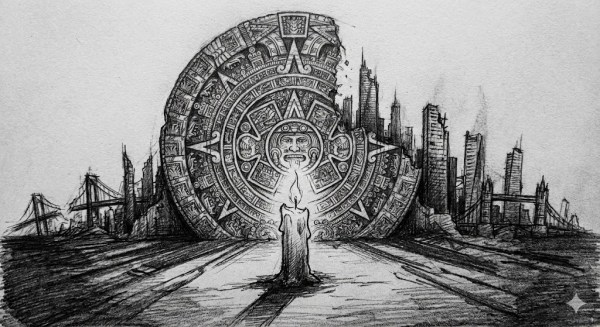
In the West, we view time as a straight line: start at Creation, end at Judgment. But for the Aztecs, the apocalypse wasn’t a future event: it was a recurring operational hazard. They believed we are living in the era of the Fifth Sun. The earlier four? Already destroyed.

And the techniques of destruction were terrifyingly specific:

  • Jaguars ate the first generation (giants).
  • Hurricanes wiped out the second (survivors turned into monkeys).
  • Fire rain ended the third.
  • A 52-year flood dissolved the fourth.

For the Aztecs, the universe was fragile. It required constant “fuel” (sacrifice) to keep the sun moving. If they stopped, the framework crashed. It’s a distinct contrast to the Hindu concept of time, which is less about fragility and more about unimaginable scale.

Hindu cosmology measures time in kalpas (4.32 billion years). The end isn’t a tragedy: it’s a factory reset. The universe dissolves into a singularity and expands again, like a divine lung breathing in and out. It suggests that destruction is just the price of admission for creation.

2. The Shift: From God’s Wrath to Human Error

Something shifted in 1945.

For millennia, the apocalypse was the domain of the divine. If the world ended, it was because we sinned. A deity would send a flood or a beast to hit the reset button. But after the atomic bomb, the narrative changed. We realized we didn’t need God to end the world anymore. We had the technology to do it ourselves.

This birthed the Secular Apocalypse, and suddenly, our fictional monsters changed:

  • The Nuclear Bomb gave us stories about radiation and the “long wait” for death (think On the Beach).
  • The Pandemic (zombies) gave us stories about the loss of self. The horror of the zombie isn’t that it kills you. It’s that it is you, repurposed by a virus or fungus.
  • Climate Change gave us the “slow violence” of the weather. This includes floods, freezes, and dust bowls. These events don’t care if you’re rich or poor.

We stopped fearing judgment and started fearing our own incompetence.

3. The “Pre-Apocalypse”: The Horror of Waiting

This is where it gets personal for me, and where the concept for Nebula Arcana really lives.

There is a sub-genre called the “Pre-Apocalyptic.” It’s not about the explosion: it’s about the Tuesday before the explosion. It’s the story of The Last Policeman. An asteroid is hitting in six months. A detective still tries to solve a murder. Why? Because he has to.

This specific anxiety: the knowledge of a finite clock: is the driving force behind our debut album, The Last Ember. We didn’t want to write songs about the fireball: we wanted to explore the 12 months before it. How do you go to work, love your partner, or pay rent when you know the date it all ends?

Research suggests we consume these stories as a form of “vicarious rehearsal”. We are practicing our emotions. In fact, a study showed that fans of apocalyptic movies coped better with the COVID-19 pandemic mental load. They had essentially “gamed out” the scenario in their heads already.

4. Interactive Doom: Why We Play with Fire

Video games have added a new layer: agency.

In a movie, you watch the hero survive. In games like Frostpunk or The Long Dark, you have to make the call.

  • Do you put children to work in the coal mines to keep the generator running? Will this save the city from freezing?
  • Do you share your food with a stranger when you’re starving?

These narratives force us to ask: Survival is insufficient. (A quote from Star Trek that became the mantra of the novel Station Eleven). If we survive the end but lose our humanity, did we actually make it?

Conclusion: The End is a Transition

We keep telling these stories, whether it’s the “Great Winter” of Norse mythology or the rogue planet in Melancholia. It’s not because we want to die, but because we want to know what matters.

The apocalypse strips away the noise. It removes the commute, the taxes, and the petty arguments. What remains is the raw core of existence. It forces us to ask: When everything else burns away, what remains?

That is the question I’m trying to answer with the music of Nebula Arcana. The end isn’t just a full stop. It’s a transition.

And if we have to face it, we should as well have a soundtrack. The Last Ember.
Reflecting on Life Choices: My Journey to 50

It’s exactly one month until my 50th birthday. That’s a good age.

I know myself – my weaknesses and my strengths – better than ever before. I understand not only who I am now, but also all the choices from my past that have shaped me into the person I am today. I’ve managed to expand my comfort zone enormously, and I’m not afraid to push it even further.

I’m no longer that naïve, gullible people-pleaser whom even those I once considered my best friends would trample over. The 25-year-old me merely watched from the sidelines as whispers began behind my back and events unfolded – events whose meanings only became clear to me much later.

In fact, I still don’t fully understand why things happened the way they did. But that no longer matters.

That thirty-something version of myself consciously set all of that aside when the same people wanted to pick up where we had left off. And so I went along with it, only to finally come to terms with those thoughts recently.

Life goes on. The old band will never return, but the new band is charging ahead at full throttle.

I harbour no bitterness, nor do I blame anyone for anything. My past has made me exactly who I am. No one now tramples over me, and I make sure not to do the same to anyone else.

True strength, after all, does not mean a lack of empathy.

Blending Dark Dystopian Undertones with Progressive Elements

As I dive into my latest musical project, I find myself reflecting on the path that’s led me here. The new music I’m creating can be described as diverse, progressive, melancholic melodic death metal, blending growling and clean vocals. In a way, it’s a return to the adventurous musical spirit Eternal Tears of Sorrow had in the 90s. I feel the same innocence and energy I had at that time.

The 90s were a defining decade for me, shaping my musical and literary influences. I delved into melodic death metal, progressive metal, and science fiction—genres and themes that have stayed with me ever since. I discovered artists who would profoundly impact my creative direction. These included Devin Townsend and Anneke van Giersbergen with The Gathering. I also explored dystopian literature like 1984 and Fahrenheit 451. These influences have always been a part of me, even if they couldn’t fully manifest within EToS.

EToS was a collective effort, with our music being a blend of everyone’s ideas and preferences. This collective approach was rewarding but also limiting. Now, with the band on hiatus, I’ve found the freedom to explore new sonic territories that show my true self.

Books (and TV shows) like Good Omens and Station Eleven have also deeply influenced this new chapter. Good Omens taught me about the melancholic balance between light and dark. This contrast is something I’ve always explored in my music. Station Eleven resonated with its message that “survival is insufficient,“. It emphasised the importance of art and beauty, especially in dire times. These themes are guiding my current work, which seeks to blend progressive elements with darker, dystopian undertones.

This project marks my first thematic album, and it’s a thrilling challenge. It’s about rediscovering that sense of innocence and curiosity in songwriting. It’s about exploring uncharted creative spaces. It’s about weaving together the diverse influences that have shaped me. There are echoes of my past work. This new venture is about pushing boundaries. It’s about seeing where this renewed creative freedom takes me.

I’m eager to share more as this journey unfolds. The path ahead is filled with unknowns, but that’s what makes it so exciting.

Embrace Diverse Tastes in Music

Recently, I read an interview with former Megadeth bassist David Ellefson, where he discussed how, in the 90s, metal fans couldn’t admit to liking Nirvana. It was true then, and to some extent, it remains true today. Many metal enthusiasts either don’t want to listen to anything outside of metal or at least don’t want to admit it. This doesn’t apply to everyone, but it does to many.

The same goes for ABBA. Timo Tolkki from Stratovarius mentioned that in the 90s, he couldn’t tell anyone he liked ABBA. In the 70s, many dismissed ABBA as frivolous pop music. Indeed, the band played pop, but in hindsight, ABBA’s melodies were, and still are, in a league of their own compared to many other 70s pop melodies.

This attitude extends to metal musicians as well. Many bands playing old-school death metal in the 2020s wouldn’t dream of incorporating anything other than traditional death metal into their music. Fortunately, some think outside the box, as the English saying goes.

Then again… Who am I to dictate the right or wrong way to proceed? AC/DC has essentially been making the same album over and over for over fifty years, and few people wonder, “Why don’t they try something new?” AC/DC is AC/DC, and that’s how it should be.

You know, there are reasons for everything. If a band’s primary job is being a band, and each member has a family to support and a mortgage to pay, it’s understandable that they wouldn’t want to change their style drastically. They have to make a new album every three years and then go on tour to earn money for food and rent. It’s a job like any other, though perhaps different from 95% of other jobs.

This is one of the main reasons I’ve never wanted to be a full-time musician.

Firstly, what on earth would I do in my free time if I made music for at least eight hours a day?

Secondly, I currently value the freedom of making music more than ever. I can calmly think about new songs, experiment, and fail many times before I have an album’s worth of material. I have a loose schedule (I hope to have about half the songs for the upcoming album ready by the end of this year, or at least four songs), but schedules can change because I’m only accountable to myself.

And I can also say: the album will feature a variety of music. Mostly metal, and heavy and dark at that, but also influences from bands like Cardiacs, Spock’s Beard, Alcest, Porcupine Tree, Panic Room, and Tinyhawk & Bizarro. There will be orchestral, symphonic, and dark melodic death metal. It will be melancholic, but not gothic. Let others who prefer that genre create gothic metal.

Or, actually, who knows what the album will ultimately sound like? The final outcome could be anything. I’ve only written songs for half a year or so… And I have one song that will definitely be an integral part of the album. For the rest of the songs, I have some ideas and thoughts, but they can change.

I do know that the last EToS album was released over ten years ago. Which in the world of music is forever. And this isn’t even going to an EToS album but something entirely new, as these songs aren’t going through the usual EToS songwriting process. Far from that. It’s going to be something completely different. Or, at least, different.

So…. Getting back to the thought I started the post with. Think of a hundred years from now. Few of us will still be alive then. Will people care about what music you said you listened to? Probably not. Listen to what you want. Be yourself. Be creative in your own way, because nobody else will. Don’t hide your light under a bushel.

A question for you:

Is there a band you just can’t admit to liking?

Progressive Melancholy: Crafting Dynamic and Versatile Melodic Death Metal

The world is in a dark place these days. Democracy seems to be deteriorating across the West, and many people are yearning for strong leaders, which feels strange to me. Over the past century, mankind has found more and more ways to destroy itself, casting a shadow over our future. In times like these, music becomes essential. It has the power to wake people up and console them in their fears.

Given this backdrop, my music must reflect the melancholy and scariness of the current times. Metal, in particular, needs to evoke a sense of fear and unease. This is how Black Sabbath came up with the idea of heavy metal. According to Wikipedia, “A cinema across the street from the band’s rehearsal room was showing the 1963 Italian horror film Black Sabbath […]. While watching people line up to see the film, Butler noted that it was strange that people spend so much money to see scary movies.” So, scariness equals metal. Melancholy also equals metal, in my opinion. Therefore, my music must be heavy, dark, and melancholic, yet diverse and dynamic.

About my new band… My songwriting process has been slow, as my primary job consumes most of my weekdays. However, I’m excited to share that I’ve managed to write what I believe is the best song of my life. It’s a bit unusual, as I experimented with my 7-string guitar, tuning it to dropped G instead of my usual one-step down to A. Despite this, the song doesn’t sound overly heavy. At times it does, but it also has moments that sound almost happy.

In general, everything seems to be progressing according to the plan I made last winter. My goal is to write more songs and create demos. Once I have at least 40 to 50 minutes of music, I’ll start thinking about the lyrics. After that, I may write more music. Eventually, the band will need more members to take it to the next level.

A few weeks ago, I read something Kerry King said about his solo project. He mentioned that you get lazy in a long-established band because you only need to focus on your own role. In your own band, you have to take responsibility for everything, which makes things slower and harder. He’s absolutely right; this is not as easy as it is with an established band.

But it’s worth it. I’ve already got many ideas that I could never have executed before. A theme album or a concept album? We shall see. Ideas influenced by Porcupine Tree, Tool, or even Spock’s Beard? I have some of those too, although the backbone of these songs remains melodic death metal. As they say, a leopard cannot change its spots. In the ’90s, with the other EToS guys, I learned what’s important in metal music: heaviness, melodies, versatility, and dynamics. Those elements remain.

Even though I think Slayer‘s Reign in Blood is one of the best metal albums ever, I would never write an album like that. Shadows need light for contrast, and heaviness needs melodies. This is what melodic death metal is: a genre but also a philosophy. It’s almost as if melodic death metal requires bands to surprise their listeners; you should never know what’s coming next when listening to a brand-new album. That’s my perspective, anyway.

So, ideally, this album should have a loose theme, but each song should have its own character and story. Perhaps something like Black Mirror meets The Twilight Zone meets The Outer Limits meets Tales from the Crypt. However, this depends on how the songs turn out. My initial wish was for these songs to be heavier, darker, and more progressive than anything I’ve done before. But I don’t think that’s going to happen. Instead, there are some new elements, but the melodies and melancholy are still there.

I know there will be less gothic metal and more progressive ideas. I always questioned EToS being labelled as gothic metal, even though it is partly true, as we were influenced by Paradise Lost when we started. I mentioned “melancholy” earlier, and that will remain. However, “melancholic” does not equal “gothic” to me, even though they do somewhat overlap. For me, melancholy is the opposite of happiness, so melancholic music is definitely not happy music. And I couldn’t write anything happy anyway.

Why melancholic? As I mentioned at the beginning of this post, the world isn’t quite a happy place right now. Music is a perfect way to convey these fears.

So, heavy, dark, and melancholic it is, and always will be.

Artistic Growth: Embracing Feedback and Originality

  1. Learn Something New All The Time: Curiosity, Passion, Discipline, Creativity

Every day, or at least every week, try to learn something new. Listen to new music, especially something entirely different from your own style or preferred genres. Perhaps you need to delve deeper into music theory: chords, chord progressions, scales, rhythm, melodies, harmonies—whatever it may be.

It’s essential to learn how to write good songs and continuously improve with each new composition. There are no shortcuts; you learn by doing.

No matter your daily activities, make learning a habit. Spending just 15 minutes a day on learning can make a significant difference over time.

  1. Opinions from Other People: Feedback, Constructive Criticism, Listen to and Learn from Others

No man is an island,” John Donne wrote, and it’s true. Even if you think you’re writing just for yourself, you still smile when others enjoy your music. They may have critiques, but remember, that’s just their opinion. Try to see your work from their perspective for a moment.

  1. Learn to Play Your Instruments Well: Practice, Practice, Practice. Learn. Practice More

Master your instrument, whatever it is. Practice singing or playing regularly. Experiment with other instruments or try playing your guitar upside down with your “wrong” hands.

If your DAW is your instrument, treat it as such. It’s often one of the most critical tools you need to master. Use it, experiment, and continuously learn new techniques.

  1. Do Many Good Live Shows

Play as many shows as you can. Analyse your performances and learn from your mistakes. Then play more shows.

If live performances aren’t for you, find other ways to promote your music effectively.

  1. Make Great Recordings

By now, you should be well-prepared. Secure a great record deal, go to a reputable studio, and record your songs meticulously. Mix and master them with care.

If you choose to mix and master your recordings yourself, ensure you have the necessary skills (see ).

  1. Be Original

This is the hardest yet most crucial task. Be original. Be yourself. Be unique, different, creative, and innovative. Be a leader, a trendsetter, a game changer, and ultimately, a legend.

  1. Establish Good Routines

Set up your environment to facilitate creativity. Ensure you can start creating immediately without spending 30 minutes preparing your gear. This way, you won’t lose the magical moment of inspiration.

  1. Don’t Take It Too Seriously

Music, it’s just entertainment, folks!” (as Devin Townsend says). “Art is too important to be taken seriously” (as Oscar Wilde notes).

For perspective: in 100 years, no one will remember you personally. However, people may still listen to and remember your music.

  1. Critics Are Both Right and Wrong

Critics are simply doing their job: listening to music and sharing their feelings about it. Honest reviews benefit everyone, so consider their feedback.

However, a review is just one person’s opinion. A bad review isn’t the end of the world. Some people won’t connect with your music, and that’s okay. Learn from feedback and move forward.

  1. A Practical Piece of Advice: Back Up Everything

This might be the most underrated yet crucial advice. Always back up your work. Losing a great song because of a computer crash can be devastating. Ensure you have backups to avoid such losses.

Time Passes by So Quickly…

As my 49th birthday looms on the horizon next month, I find myself reflecting deeply on the journey so far.

It’s been a rollercoaster of discovery. Looking back at the turn of the millennium, I realize how much I’ve learned. The band was my everything, a crucial part of my identity, but I’ve come to understand that such heavy reliance wasn’t the healthiest in the long run.

Back in ’99, being in a band felt entirely different. The internet was just a baby, and social media was nowhere on the horizon. We only had the Web, no Instagram, Facebook, TikTok, YouTube – not even Napster or Myspace for sharing our music. Bands weren’t tied down by the need for constant online promotion. Today, however, crafting an engaging online presence is crucial, a challenging shift for someone from the old school like me. But, every day is a chance to learn and adapt.

One reflection that’s particularly resonated with me was seeing our album ‘Chaotic Beauty‘ described as ‘Progressive Death Metal’ – a rare but insightful categorisation. This acknowledgment of the complexity and depth of our work has significantly influenced my recent musical endeavors.

Now, I’m quietly working on something new, a project that’s been simmering since the start of this decade. It pays homage to familiar territories while venturing into new realms, blending the old with the new. This venture feels like coming full circle, marrying past lessons with future opportunities. 🌌

Life, I’ve realized, is about continuous learning and adaptation. From the seismic shifts of the early noughties to navigating today’s digital landscape, every step has been preparation for this moment. As I stand ready to embark on this new chapter, I’m filled with excitement and a touch of nerves for the adventures that lie ahead.

I’m finally ready for this next journey. Allons-y, then! And stay tuned for more details in the near future.

Blog at WordPress.com.

Up ↑