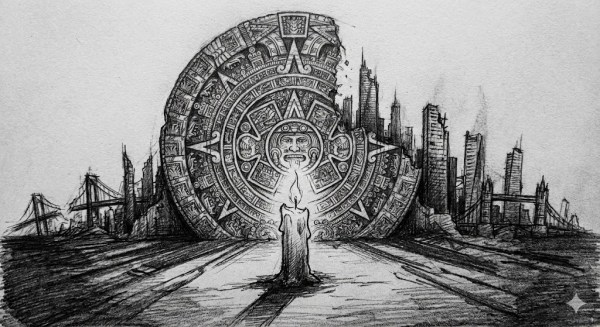
The apocalypse isn’t just a genre. It’s a mirror.
From the moment we figured out time moves ahead, we’ve been obsessed with the moment it stops. We gather around a campfire sharing myths. Or, we doom-scroll on Twitter/X. Humanity has a strange, persistent hobby: we love rehearsing our own extinction.
As I’ve dug into this research for my blog, I’ve made discoveries. It has fuelled the concepts behind Nebula Arcana. I’ve realized that the “End” is rarely about death. It’s a diagnostic tool for the living. The monsters we invent are jaguars, floods, or AIs. They tell us exactly what we are afraid of right now.
Here is a tour through the architecture of the end: and why we can’t look away.
1. The Universe as a Buggy Software Update
If you think the world feels unstable today, you should see the Aztec maintenance schedule.
In the West, we view time as a straight line: start at Creation, end at Judgment. But for the Aztecs, the apocalypse wasn’t a future event: it was a recurring operational hazard. They believed we are living in the era of the Fifth Sun. The earlier four? Already destroyed.
And the techniques of destruction were terrifyingly specific:
- Jaguars ate the first generation (giants).
- Hurricanes wiped out the second (survivors turned into monkeys).
- Fire rain ended the third.
- A 52-year flood dissolved the fourth.
For the Aztecs, the universe was fragile. It required constant “fuel” (sacrifice) to keep the sun moving. If they stopped, the framework crashed. It’s a distinct contrast to the Hindu concept of time, which is less about fragility and more about unimaginable scale.
Hindu cosmology measures time in kalpas (4.32 billion years). The end isn’t a tragedy: it’s a factory reset. The universe dissolves into a singularity and expands again, like a divine lung breathing in and out. It suggests that destruction is just the price of admission for creation.
2. The Shift: From God’s Wrath to Human Error
Something shifted in 1945.
For millennia, the apocalypse was the domain of the divine. If the world ended, it was because we sinned. A deity would send a flood or a beast to hit the reset button. But after the atomic bomb, the narrative changed. We realized we didn’t need God to end the world anymore. We had the technology to do it ourselves.
This birthed the Secular Apocalypse, and suddenly, our fictional monsters changed:
- The Nuclear Bomb gave us stories about radiation and the “long wait” for death (think On the Beach).
- The Pandemic (zombies) gave us stories about the loss of self. The horror of the zombie isn’t that it kills you. It’s that it is you, repurposed by a virus or fungus.
- Climate Change gave us the “slow violence” of the weather. This includes floods, freezes, and dust bowls. These events don’t care if you’re rich or poor.
We stopped fearing judgment and started fearing our own incompetence.
3. The “Pre-Apocalypse”: The Horror of Waiting
This is where it gets personal for me, and where the concept for Nebula Arcana really lives.
There is a sub-genre called the “Pre-Apocalyptic.” It’s not about the explosion: it’s about the Tuesday before the explosion. It’s the story of The Last Policeman. An asteroid is hitting in six months. A detective still tries to solve a murder. Why? Because he has to.
This specific anxiety: the knowledge of a finite clock: is the driving force behind our debut album, The Last Ember. We didn’t want to write songs about the fireball: we wanted to explore the 12 months before it. How do you go to work, love your partner, or pay rent when you know the date it all ends?
Research suggests we consume these stories as a form of “vicarious rehearsal”. We are practicing our emotions. In fact, a study showed that fans of apocalyptic movies coped better with the COVID-19 pandemic mental load. They had essentially “gamed out” the scenario in their heads already.
4. Interactive Doom: Why We Play with Fire
Video games have added a new layer: agency.
In a movie, you watch the hero survive. In games like Frostpunk or The Long Dark, you have to make the call.
- Do you put children to work in the coal mines to keep the generator running? Will this save the city from freezing?
- Do you share your food with a stranger when you’re starving?
These narratives force us to ask: Survival is insufficient. (A quote from Star Trek that became the mantra of the novel Station Eleven). If we survive the end but lose our humanity, did we actually make it?
Conclusion: The End is a Transition
We keep telling these stories, whether it’s the “Great Winter” of Norse mythology or the rogue planet in Melancholia. It’s not because we want to die, but because we want to know what matters.
The apocalypse strips away the noise. It removes the commute, the taxes, and the petty arguments. What remains is the raw core of existence. It forces us to ask: When everything else burns away, what remains?
That is the question I’m trying to answer with the music of Nebula Arcana. The end isn’t just a full stop. It’s a transition.
And if we have to face it, we should as well have a soundtrack. The Last Ember.

 Jarmo Puolakanaho
You must be logged in to post a comment.